
Packaging design is not strategy—packaging design is merely the expression of strategy. If the strategy is wrong, no matter how good-looking the packaging is, it will still fail to drive sales. Excellent packaging design always serves sales!
A while back, an owner of a rice-milk beverage brand came to me, extremely anxious: he'd picked up a couple of tricks online and said he wanted to "build a brand," asking me to make the packaging more upscale and create an IP character too.

A while back, a boss who makes rice-milk drinks came to me, in a real hurry: he’d picked up a couple of tricks online, said he wanted to “build a brand,” and asked me to make the packaging look fancy, throw in an IP character, and ideally print on elements like wheat ears, sunshine, and health.
My head hurt a little listening to it. He wasn’t the first to say this, and probably won’t be the last.
Rice milk has a particular trait: it’s a breakfast-scene product, competing with soy milk, congee, and milk. Customers buy it for one thing—“a cup in the morning, warm and filling.” You come in right away wanting “fancy,” “IP,” “health elements”—these words all sound right, but put together, they’re just four words: no focus.
I did three things for him, all clumsy, unglamorous work related to the “marketing system.”
First, forget whether the packaging looks good for now—get clear on “who you’re selling to and where you’re selling.” His channels were convenience-store breakfast cases and community group buying. So I built it for that scene: a white bottle with a wheat-ear illustration, lots of white space on the label, and the front main visual just the three characters “Mi Xiaobao” plus a small sprig of wheat, in a warm yellow tone that looks toasty at a glance.

— Mi Xiaobao rice milk bottle with wheat-ear light and shadow scene
Not like the brightly colored drinks in the supermarket—more like a cup of congee kept warm at a breakfast stall. At the time the client asked whether we should print “zero additives” and “freshly ground” on the front. I said not yet—the front is there to say hello; put those on the side, and let customers read them once they pick it up.
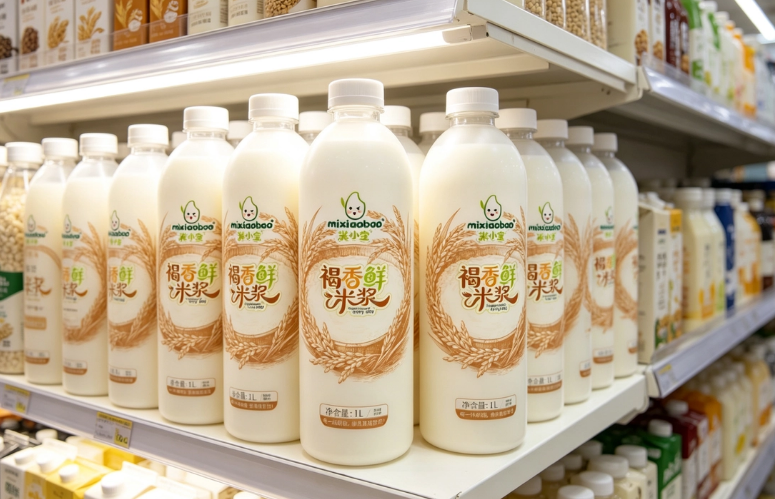
— Real shot of shelf display in a supermarket breakfast case
Second, I told him packaging is just one part of the tactics. In convenience stores and community group buying, customers are rushing for the subway at seven in the morning—you think they’ll scan a code and watch a video? No way. What you should do is: print “microwave 30 seconds” on the side of the packaging so the breakfast-shop owner gets it at a glance; run a “second cup half price” in the group-buy chat so people are willing to try a second time. These are far more useful than a flashy IP.
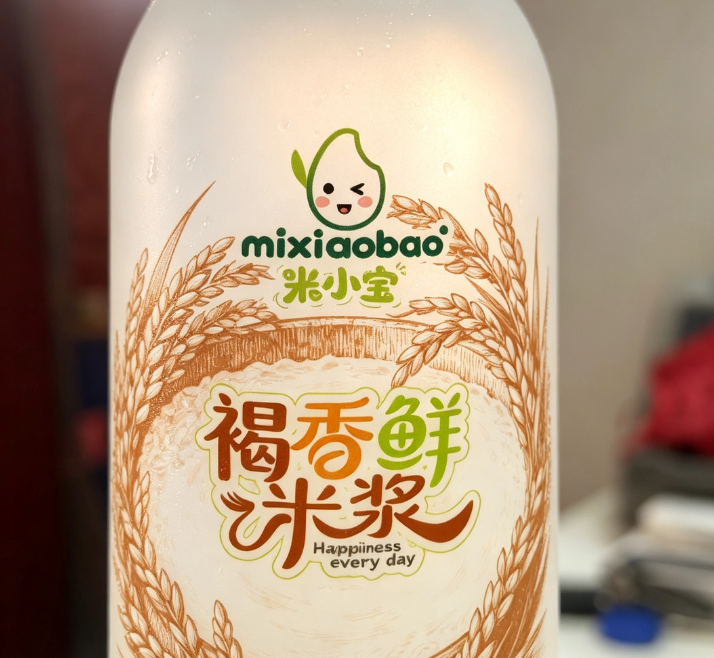
— Close-up of bottle label and cartoon rice-figure LOGO
Around that time we deliberately drew several drafts of the cartoon rice figure on the label—round face, squinting eyes, hugging a bundle of wheat. The client said the little guy was cute and asked if we could make it bigger. I said let it show up where it should first—on the bottle, on the group-buy posters, on the price tags in the breakfast case, consistent in all three places. That’s more useful than making it bigger.
Third, I advised him not to rush the packaging change. He still had a batch of old inventory, so I said finish selling this batch first, and when the new packaging launches, run a “new look” event—old customers snap a photo of the old one and get a free cup of the new to try. Turn the packaging change into an interaction with old customers, not just a reskin.
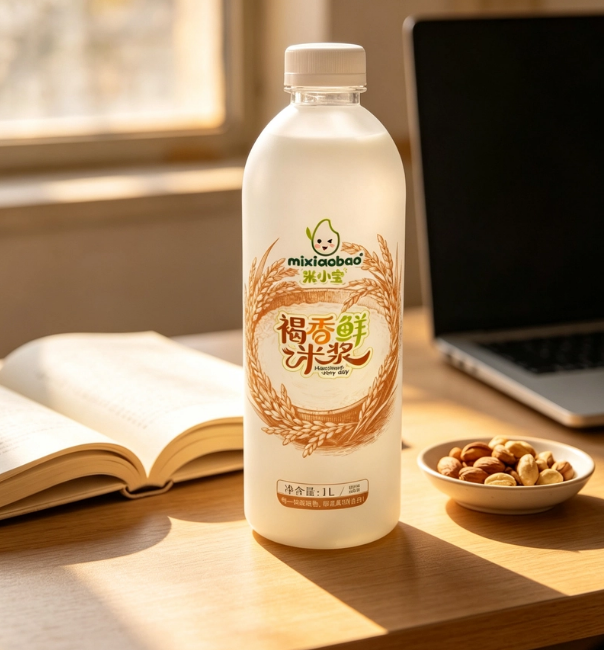
— Real shot of everyday drinking scene at an office desk
So packaging isn’t everything, but packaging is the hook that “makes people stop.” Once you’ve hooked them, something has to catch them after.
Packaging is responsible for getting people to pick it up, the product is responsible for getting people to drink it, and repeat purchase is responsible for getting people to pick it up again. String these three together and that’s what you call marketing. Miss the last two links, and no matter how good the packaging looks, it’s a one-time deal.
Later he asked me whether he still needed the IP character. I said talk about it when you have dozens of stores and need to speak to young people—for now, focus on selling every cup. If this advice had reached him earlier, he could have saved half a year of detours.
Honestly, I only understood this after stepping in pits myself. A few years back I took a job where the client insisted on a full brand upgrade—LOGO, IP, and packaging all at once. It took nearly half a year, and the shelf performance didn’t improve. Only when we reviewed it did we realize he hadn’t even thought through his channels—goods were spread across three platforms, each with different users, and one set of packaging simply couldn’t cover them all.
Since then I’ve made it a habit: before taking a job, ask the client three things—who are you selling to, where are you selling, and how do you get people to buy again. If they can’t answer those three, no matter how pretty the packaging, I’ll advise them to go back and think first.
This isn’t throwing cold water—it’s saving you money.
Sanyao Packaging
Good packaging speaks.
About This Case: Quick Answers
Can this "marketing" playbook work for my beverage product too?
Yes. This logic isn't picky about category—it works as long as your product looks pretty much like everyone else's on the shelf and consumers can't recognize you in three seconds. When it comes to execution, we'll build a new plan around your category, channel, and price band rather than forcing someone else's face onto yours.
What do you typically charge for beverage packaging, and how long does it take?
We charge per project, based on category complexity, the number of series, and whether prototyping extensions are included. Typically 2–4 weeks: the first week sets direction and positioning, the second week delivers concepts, and the third and fourth weeks refine, prototype, and finalize. Rush jobs can be compressed, but we recommend leaving time for physical prototyping. Send us your materials for a free diagnosis before we quote.
We're based out of town—can we collaborate online?
Yes. Many of our projects are remote collaborations: materials coordinated online, concepts reviewed in the cloud, and prototypes shipped by courier. There are no geographic limits—we work with clients nationwide.
Is packaging a cost or an asset?
It's pricing power. Treat it as a cost to cut, and it gets clawed back out of your selling price; treat it as an investment, and it tells your story of value before the consumer even reaches for their wallet. Great packaging does just one thing: it makes the product look—and genuinely be—worth that price.

CommentsBe kind, communicate rationally