
Thinking about integrated marketing for a small or mid-sized distillery? Hold off — unify your overall brand image and packaging design first, and you'll get twice the results with half the effort!
A client who makes sorghum baijiu came to me and said right off the bat: I want to do "integrated marketing" — the big brands all do it, blanket every channel, make a big splash. I asked him: do you

A client who makes sorghum baijiu came to me and opened with: I want to do “integrated marketing.” The big brands all do it — spread across every channel, make a big splash.
I asked him: What’s your budget?
He said: Two hundred thousand a year.
I said, then that two hundred thousand of yours — if you try to copy the big brands’ “spread across every channel,” it’ll be gone in a month. Integrated marketing is something the big brands play with land, sea, and air. At your scale, you need to play “single-point breakthrough.”
He wasn’t convinced: So I don’t deserve to do integrated marketing?
I said you do, but first you have to get clear on what integrated marketing actually is. It’s not flooding every channel — it’s saying “one voice” a hundred times everywhere your customers can encounter you. Big brands spread channels; small brands unify their voice. What you need to do isn’t get more people to see you — it’s get the people who see you to remember you.
Later we sat down and went through everything he had: sorghum grown in black soil, traditional craft, a few distributors, a Taobao store that had just opened, a few hundred acquaintances on WeChat Moments. That little bit of resource — how do you integrate it?
The answer was one sentence: take the story of “black-soil old sorghum” and tell it in the same look, everywhere.
The first thing we did was give this baijiu a “face.” The bottle is a dark, flat, square bottle with a black matte finish; the label is gold embossed paper with a fine brushed texture, hot-stamped in gold with a sun, sorghum ears, and mountains and water — that whole set from the Northeast, and at a glance it’s clearly something from the black soil. The main title, the characters “Zhaodong Da Gaoliang,” is hot-stamped in relief — hit it with light and it stands right up.
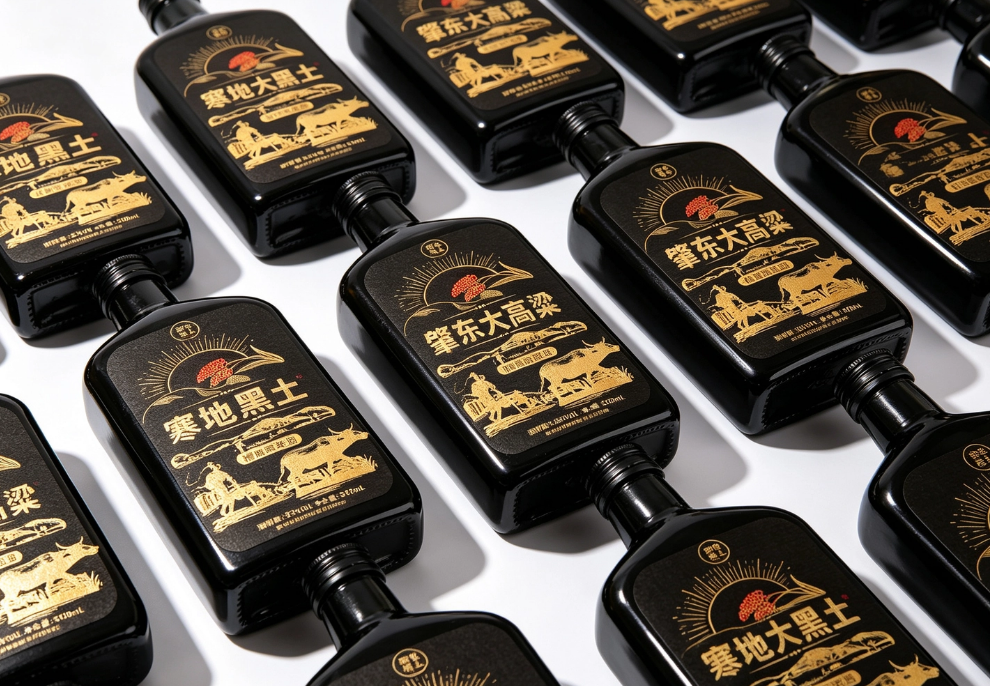
— Top-down shot of multiple bottles with unified visual on white background
The client asked me: Why embossed paper? It’s so expensive. I said your baijiu is all about “old brand, real craft” — ordinary glossy paper prints up looking flimsy, while embossed paper has texture and thickness, and the moment you touch it there are just two words: solid. Customers can’t see the old steamer where you brew, but they can feel the care in this layer of paper.
The cap is a black metal screw cap, holding the same tone as the bottle.
The second thing: use this face everywhere. The WeChat Moments poster uses this image, the Taobao detail page uses this image, the flyer for distributors uses this image, and even the bubble wrap on shipments had a little label stuck on it — “Sorghum baijiu from the black soil.” The client said: Isn’t this making a big deal out of nothing? I said remember, the first rule of integrated marketing isn’t how big the budget is — it’s that every touchpoint says the same sentence. The customer sees you on WeChat Moments today, sees you on Taobao tomorrow, and sees you the day after when the package arrives — three times, the same image, and he remembers.
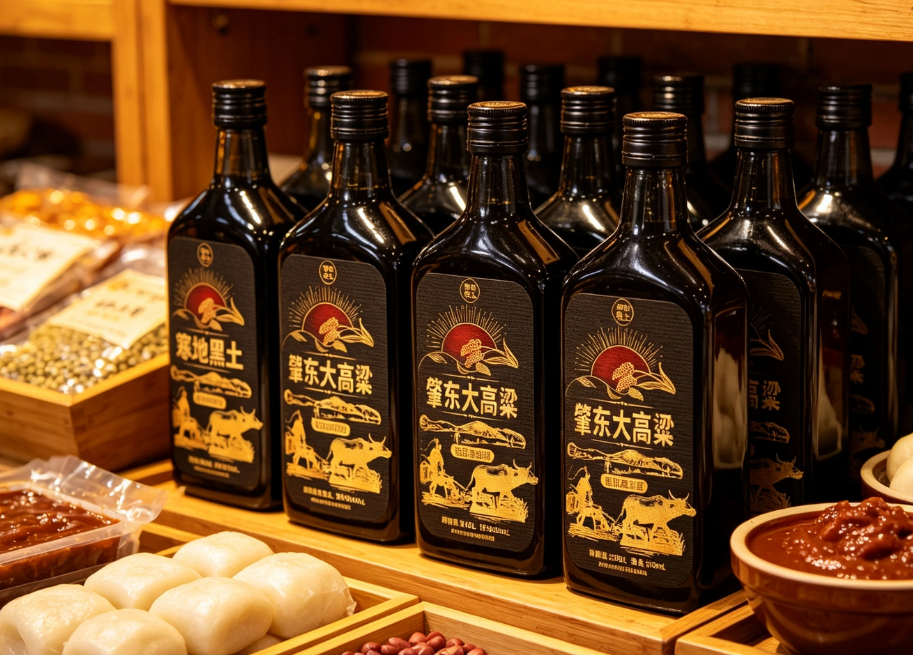
— Lifestyle display on a wooden rack
The third thing: cut the noise. Originally his WeChat Moments had a promotion one day, chicken soup for the soul the next, and photos of his kid the day after. I said for this one month, don’t post anything else — just post “black soil”-related stuff: go to the distillery and shoot the old steamer, the fermentation pits, the sorghum fields. After a month of posting, he told me: two old classmates took the initiative to ask him how much the baijiu costs, saying that seeing him post about the distillery every day made it feel pretty solid.
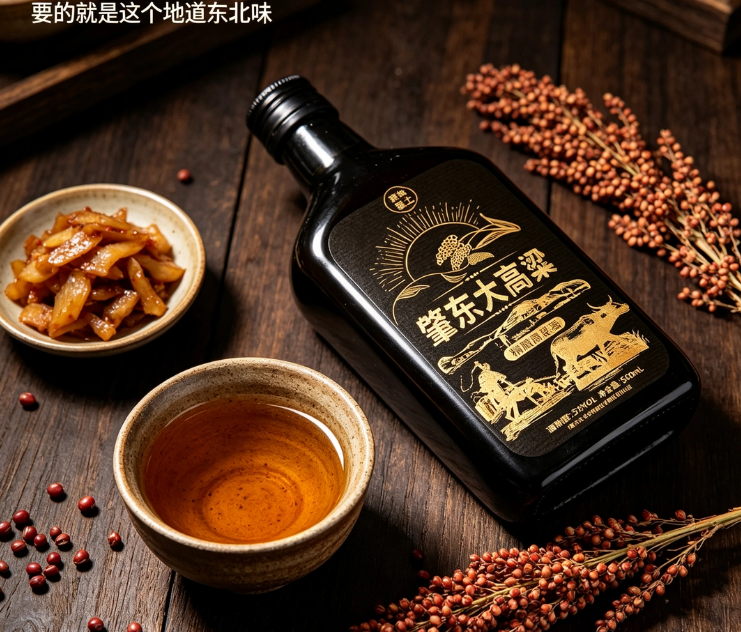
— Still life of baijiu bottle, cup, and sorghum ears
See, this is what “consumer-centered, unified message” means. Integrated marketing sounds fancy, but brought down to earth for a small brand, it’s three things: speak plainly, say the same thing, and keep saying it.
He said something that struck me: I always thought building a brand was a big-company thing, but now I realize a small factory can have its own “face” too.
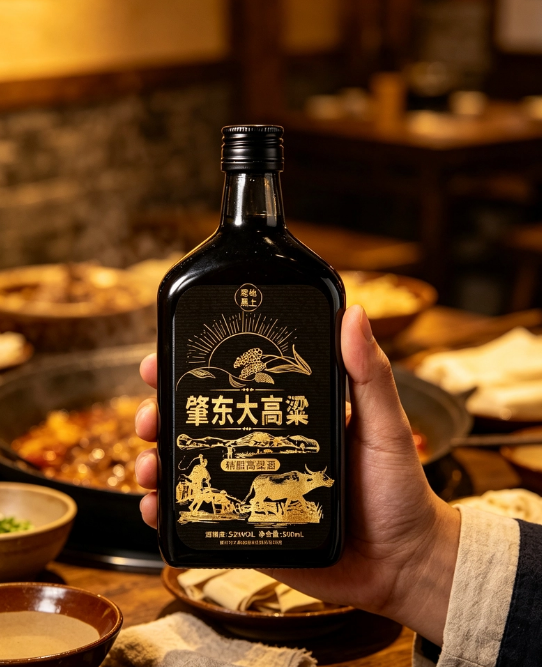
— Dining scene with a hand holding the bottle
I said exactly — big factories have big-factory ways, small factories have small-factory ways to survive. Don’t worry about land, sea, and air for now; get your face unified first, then talk about the rest.
Sanyao Packaging
Good packaging speaks
About This Case: Quick Answers
Are finishing processes on packaging (foil stamping, matte coating, etc.) worth it?
Spending a few extra dimes to a dollar per bottle buys you a texture that catches the eye instantly under the counter lights, and the gut feeling that "this bottle isn't cheap." Finishing isn't showing off technique—it's money spent to make consumers willing to believe it's worth the price, and that dollar comes back doubled in the selling price.
Can my product use the product approach described in this article?
Yes. This logic doesn't discriminate by category—as long as your product looks about the same as everyone else's on the shelf and consumers can't recognize you in three seconds, it works. When it comes to execution, we'll set a new plan based on your category, channel, and price band rather than forcing someone else's face onto yours.
What do you typically charge for product packaging, and how long does it take?
We charge per project, depending on category complexity, the number of series, and whether prototyping and extensions are included. Typically 2–4 weeks: week one sets direction and positioning, week two delivers concepts, and weeks three and four refine, prototype, and finalize. Rush projects can be compressed, but we recommend leaving time for physical prototyping. Send us your materials for a free diagnosis first, then we'll quote.
We're in another city—can we work together online?
Yes. Many of our projects are remote collaborations: materials coordinated online, concepts reviewed in the cloud, prototypes shipped by courier. There are no geographic limits—we work with clients nationwide.
CommentsBe kind, communicate rationally